
When the brain ‘glitches’ – recognising and managing functional neurological disorder
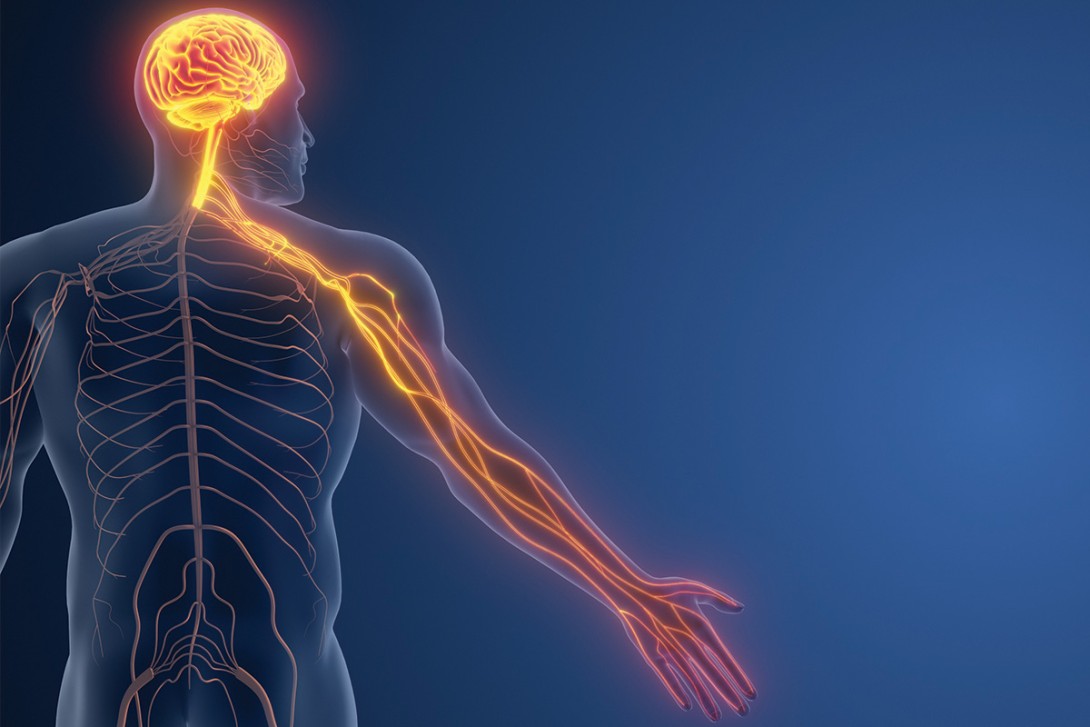
Functional neurological disorder is a common, disabling and often misunderstood cause of neurological symptoms that is seen in general practice. Recognising positive clinical signs and providing a clear, empathetic explanation to affected patients are key to management. GPs play a central role in diagnosis, co-ordination and long-term patient support.
- Functional neurological disorder is (FND) a common and disabling condition often seen in primary care.
- Diagnosis of FND should be based on positive clinical signs and features, not made by exclusion.
- A clear and empathetic explanation is central to patient engagement and effective management of FND.
- GPs play a pivotal role in the long-term co-ordination of care for patients with FND, managing comorbidities and providing reassurance.
- Early recognition of FND and clear explanation of the disorder to patients can reduce unnecessary investigations and healthcare use.
- Referral of patients with FND is often appropriate but should be collaborative, ensuring patients feel supported rather than dismissed.
Patients presenting with neurological symptoms that do not follow classic disease patterns are common in general practice.1 These patients may experience weakness, tremor, seizures or sensory symptoms, yet investigations are often normal. For many GPs, this creates uncertainty and therapeutic frustration. Functional neurological disorder (FND) is often a cause of such presentations. This article offers practical guidance on when to consider FND, how to make the diagnosis, how to explain it effectively to patients and how to support patients in ongoing management.
What is functional neurological disorder?
FND is a condition in which patients experience neurological symptoms because of changes in brain function rather than structural disease. Unlike conditions such as stroke or multiple sclerosis, FND is not characterised by tissue damage or visible lesions on imaging. Instead, the nervous system is functioning abnormally, often in a way that is reversible.2
Common symptoms include limb weakness, abnormal movements such as tremor or dystonia, functional seizures (which can resemble epileptic seizures but are not caused by abnormal electrical discharges), gait disturbance and sensory symptoms such as numbness or tingling. These symptoms are real and often cause significant distress and disability.3 A helpful analogy for patients is: ‘Your brain hardware is intact, but the software is glitching’. Framing the condition in this way validates the symptoms and introduces the possibility of improvement.
FND is not rare. It is among the most common diagnoses in neurology outpatient clinics, and functional symptoms are seen in up to one in five presentations in primary care.1,4
When to suspect functional neurological disorder
GPs should consider FND in any patient with neurological symptoms, particularly when symptoms have a sudden onset, appear inconsistent or fluctuate over time.5 For example, a patient may have a tremor that disappears when distracted, or weakness that improves when the affected limb is used in a different context.
Common clinical indicators for FND include:
- symptoms that change during the course of the examination
- tremors or spasms that improve with distraction
- positive signs such as Hoover’s sign, where apparent weakness improves when the contralateral limb is activated.6
It is important to note that FND should not be diagnosed solely on the presence of psychological comorbidities or recent stress. It is a positive diagnosis based on characteristic clinical findings, not a diagnosis of exclusion. Even in patients with confirmed FND, clinicians should remain alert to possible coexisting conditions, including those in a prodromal stage – a patient with early Parkinson’s disease may also have a functional tremor, and functional seizures can occur alongside syncope or epilepsy.7
Making the diagnosis
Ideally, FND should be diagnosed by a neurologist with expertise in the relevant area. When a patient presents with new neurological symptoms, the GP’s role is to assess for possible differential diagnoses and arrange appropriate referrals, further investigations or specialist input when needed.
The hallmark signs of FND are inconsistency and incongruity.
- Inconsistency: symptoms vary depending on context or attention. For example, a tremor may appear during direct observation but vanish when the patient is distracted. Or the patient may have weakness that improves when they perform a simultaneous task with the other limb.
- Incongruity: clinical features are absent in comparable neurological conditions or appear to defy the usual rules of anatomy, biology or physics.
Inconsistency remains a key positive sign, but incongruity can be more challenging to assess. Determining whether a symptom is incongruent with neurological disease depends largely on clinical experience and on assumptions about what is anatomically or physiologically possible – assumptions that may change as understanding of FND continues to evolve.8 Positive signs of inconsistency are valuable not only for diagnosis but also for treatment. Showing a patient that their leg becomes stronger during a specific manoeuvre can powerfully demonstrate that recovery is possible.
Sometimes additional tests may be appropriate to exclude other conditions or identify comorbidities. In such cases, patients should be informed that the likely diagnosis is FND and that the tests are being performed simply to ensure no other issues are missed, similar to ordering a scan for a patient with migraines who has mild red-flag symptoms.
The use of straightforward, nonjudgemental language is crucial. Terms such as ‘psychogenic’ or ‘pseudoseizures’ should be avoided. Instead, the term ‘functional neurological disorder’ can be used, and is becoming increasingly accepted by both patients and clinicians.9
Explaining the diagnosis
The way a diagnosis of FND is explained can significantly influence a patient’s understanding, acceptance and engagement in treatment, and has a major impact on subsequent treatment outcomes.10 Patients with FND have often encountered dismissal or disbelief from other clinicians, so a sensitive and honest approach is essential.11
Explain that FND is common, well recognised and treatable. Use clear metaphors, such as ‘a software glitch’ or ‘the brain not sending or processing signals correctly’, to bridge the gap between technical explanation and lay understanding. Emphasise that the symptoms are real and that improvement is possible. Providing written information can help reinforce the discussion. Websites such as www.neurosymptoms.org or fndaustralia.com.au offer excellent resources for patients.
Management in general practice
Once the diagnosis is made and explained, management in general practice involves ongoing support, symptom monitoring and co-ordination of care. The GP’s role includes:
- providing reassurance and continuity of care
- managing comorbidities such as anxiety, depression or chronic pain
- supporting functional rehabilitation through physiotherapy or psychology referrals
- acting as a central point for co-ordinating specialist input.
Pharmacological treatment is not effective for FND itself but may be useful in selected cases to manage comorbidities such as mental health disorders or chronic pain.
A stepped-care model is often useful.
- Step 1: diagnosis and explanation. For many patients with mild to moderate symptoms, a confident diagnosis with a clear explanation and reassurance may be sufficient.12 Improvement can begin simply through understanding the condition.
- Step 2: brief interventions. If symptoms persist, referral to allied health professionals such as physiotherapists or psychologists is appropriate. Short, structured interventions, including cognitive behavioural therapy, have shown benefit.13
- Step 3: specialist involvement. Patients with severe, persistent or complex symptoms may require further specialist input, multidisciplinary care or more intensive psychological therapy. Patients with FND often face barriers to accessing support because of limited public services and the cost of private care.14 GPs can advocate for access to these services and help patients navigate what is often a fragmented health system in Australia.
The role of the GP
The GP–patient relationship is pivotal in FND care. Patients may face long wait times, unclear care pathways or disbelief from healthcare providers. A proactive, validating GP can make an enormous difference to outcomes.
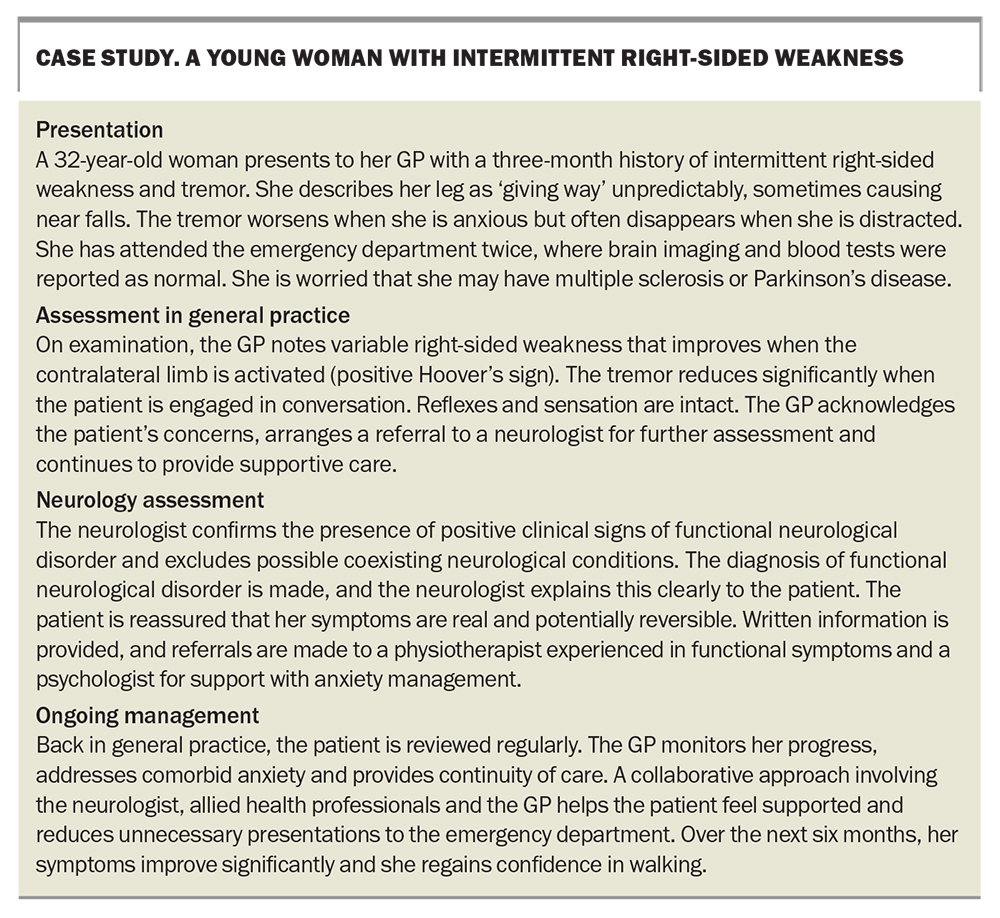
GPs should be informed of the FND diagnosis by the diagnosing clinician and should follow up the results of a patient’s referral if no outcome has been communicated. It is also important that GPs have access to education and resources to manage FND confidently. This may include continuing professional development opportunities or access to specialist advice. In regional and rural settings, where specialist access is limited, GPs may play a more central role. Telehealth consultations with FND specialists can be an effective way to support both the GP and the patient. A case study highlighting the GP’s role in the long-term care of a patient with FND is shown the Box.
Conclusion
FND is a common and disabling condition, and GPs play a pivotal role in its management. The diagnosis should be made by a neurologist based on positive findings. Clear, compassionate explanation and co-ordinated support can significantly improve outcomes. GPs are not merely gatekeepers for referral but are essential to the patient’s ongoing care and recovery. MT
COMPETING INTERESTS: Associate Professor Lehn has received grants from the Congressionally Directed Medical Research Programs, the Advance Queensland Innovation Partnerships Program and the Metro South Health Research Support Scheme for his research on Parkinson’s disease and functional neurological disorder. His institution has received payments from Seer Medical and AbbVie, and he has received payments for expert testimony from the National Disability Insurance Agency. He has participated on a Data Safety Monitoring Board meeting for QIMR Berghofer. He is a member of the Parkinson and Movement Disorders Society (MDS), MDS Scientific Issues Committee, MDS Functional Movement Disorder Study Group and Movement Disorders Society of Australia and New Zealand (MDSANZ), and is the Chair of the MDSANZ Clinical Research and Trials group. He is a founding member and board member of the Functional Neurological Disorder Society, and a board member of Parkinson’s Queensland.
References
1. Steinbrecher N, Koerber S, Frieser D, Hiller W. The prevalence of medically unexplained symptoms in primary care. Psychosomatics 2011; 52: 263-271.
2. Hallett M, Aybek S, Dworetzky BA, McWhirter L, Staab JP, Stone J. Functional neurological disorder: new subtypes and shared mechanisms. Lancet Neurol 2022; 21: 537-550.
3. Carson A, Stone J, Hibberd C, et al. Disability, distress and unemployment in neurology outpatients with symptoms "unexplained by organic disease". J Neurol Neurosurg Psychiatry 2011; 82: 810-813.
4. Ahmad O, Ahmad KE. Functional neurological disorders in outpatient practice: an Australian cohort. J Clin Neurosci 2016; 28: 93-96.
5. Lagrand TJ, Gelauff JM, Brusse-Keizer M, Lehn AC, Tijssen MAJ; other individuals of the TASMAN Study Group. Positive signs from the history as an aid for early diagnosis in functional movement disorders: the prospective TASMAN study. Eur J Neurol 2025; 32: e16525.
6. Bennett K, Diamond C, Hoeritzauer I, et al. A practical review of functional neurological disorder (FND) for the general physician. Clin Med 2021; 21: 28-36.
7. Kutlubaev MA, Xu Y, Hackett ML, Stone J. Dual diagnosis of epilepsy and psychogenic nonepileptic seizures: systematic review and meta-analysis of frequency, correlates, and outcomes. Epilepsy Behav 2018; 89: 70-78.
8. Stone J. Incongruence in FND: time for retirement. Pract Neurol 2024; 24: 163-165.
9. Stone J, Wojcik W, Durrance D, et al. What should we say to patients with symptoms unexplained by disease? The "number needed to offend." BMJ 2002; 325: 1449-1450.
10. Lagrand TJ, Jones M, Bernard A, Lehn AC. Health care utilization in functional neurologic disorders: impact of explaining the diagnosis of functional seizures on health care costs. Neurology Clin Pract 2023; 13: e200111.
11. Szasz A, Korner A, McLean L. Qualitative systematic review on the lived experience of functional neurological disorder. BMJ Neurol Open 2025; 7: e000694.
12. Stone J, Carson A, Hallett M. Explanation as treatment for functional neurologic disorders. Handb Clin Neurol 2017; 139: 543-553.
13. Espay AJ, Aybek S, Carson A, et al. Current concepts in diagnosis and treatment of functional neurological disorders. JAMA Neurol 2018; 75: 1132-1141.
14. Petrie D, Lehn A, Barratt J, et al. How is functional neurological disorder managed in Australian hospitals? A multi-site study conducted on acute inpatient and inpatient rehabilitation wards. Mov Disord Clin Pract 2023; 10: 774-782.
Further reading
Lehn A, Petrie D, Palmer D, et al. Managing functional neurological disorder: treatment recommendations for health professionals in Australia. BMJ Neurol Open 2025; 7: e000970.
Queensland Functional Neurological Disorder (FND) Special Interest Group (SIG). Managing functional neurological disorders – a state-wide recommendation for an FND clinical pathway: Queensland FND SIG; 2024. Available online at: http://fndaustralia.com.au/resources/FND-treatment-recommnedations-FINAL-20-May-2024.pdf (accessed November 2025).
Single article purchases are temporarily unavailable due to site maintenance.
If you would like to purchase an article during this time, please email us at [email protected] with the article details and we'll assist you directly. We'll also let you know when online purchasing is available again.
Thank you for your patience and understanding.