
Perinatal mental illness: a clinical imperative for whole-family care
Perinatal mental illness affects not only mothers but the entire family system. GPs have a key role in early identification through screening, taking a history of risk factors and conducting regular postpartum reviews, with a focus on integrated, whole-family care. The potential impact of parental mental illness on parenting and the flow-on effect on the child’s development, makes proactive, holistic perinatal care a clinical imperative to improve outcomes across generations.
- Perinatal mental illness is common in primary care and requires early recognition because illness can be prolonged, and suicide and overdose remain major risks in the first year postpartum.
- GPs should routinely identify symptoms and risk factors for perinatal mental illness in pregnancy and postpartum using validated screening tools, direct questions and planned follow up.
- Management of perinatal mental illness should be family-centred and collaborative, with co-ordinated care across relevant clinicians and explicit attention to the mental health of partners, as well as mothers.
- For mild to moderate perinatal depression or anxiety, evidence-based psychotherapy such as cognitive behavioural therapy and interpersonal therapy should be offered, with digital programs used to improve access when barriers exist.
- More severe presentations, suspected bipolar disorder or postpartum psychosis require urgent specialist involvement and may include pharmacotherapy, mother–baby unit pathways and targeted parent–infant interventions to protect attachment and infant development.
Perinatal mental illness affects one in five mothers and is among the most common and impactful conditions seen in primary care.1 The perinatal period encompasses the duration of a pregnancy, up until one year postpartum. These conditions include mood and anxiety disorders, as well as other psychiatric disorders. Key risk factors include a personal or family history of affective disorders, limited social support, relationship stress and childhood trauma, which can increase vulnerability and prolong illness. Suicide and overdose remain leading causes of maternal death in the first year postpartum, making early identification crucial.
Despite their prevalence, perinatal mental illnesses are often underdiagnosed and undertreated. Symptoms can persist for up to three years if left untreated, with onset occurring before conception (27%), during pregnancy (33%) or following childbirth (40%).1 The majority of affected women receive no, or inadequate, treatment, leading to significant consequences, including impaired maternal functioning (e.g. fatigue, poor decision making and difficulty bonding with the baby). These challenges often strain familial relationships, causing conflict and reducing emotional support.1
Nonbirthing parents (e.g. fathers, partners, adoptive parents) are also at risk, with up to 10% experiencing depressive symptoms during the perinatal period, often linked to role changes, financial stress and relationship strain.1 These symptoms are frequently overlooked, despite their impact on parenting and infant co-regulation.2
This article focuses on perinatal mood and anxiety disorders, with a brief mention of postpartum psychosis. Other, less frequently encountered perinatal mental illnesses are beyond the scope of this article.
Impact on infant development and family functioning
A secure parent–infant relationship is fundamental to healthy child development. Early attachment to a primary caregiver provides the foundation for emotional wellbeing and future relationships. It also underpins learning, as babies thrive when they feel safe, calm and nurtured. In contrast, insecure attachments can lead to difficulties with emotional regulation and empathy.3
When the early relationship is marked by anxiety, neglect or parental overwhelm, this can set in motion a cycle of vulnerability, starting with preschool challenges such as behavioural issues, anxiety and learning difficulties, and increasing the risk of later mental illness.4 Disrupted interactions between parent and infant from as early as three months of age have been linked to poorer cognitive, emotional and sensorimotor outcomes.3,4
Developmental delays in the first years of life often widen over time rather than resolve.4 Environmental factors such as alcohol and drug exposure, and chronic stress, can affect genetic functioning. Parental mental ill health, such as depression or anxiety, during the first 1000 days, can reduce responsive caregiving and increase stress exposure. This may not only affect brain development but can also influence gene expression through epigenetic mechanisms.5-7 These changes can shape brain development, emotional regulation and overall wellbeing, with some effects potentially passed on to future generations.1
It is important to note, however, that infants and toddlers have remarkable neuroplasticity, allowing recovery when conditions improve.1 Supportive interventions – stable caregiving, positive social interactions and early mental health support – aid in fostering resilience in families and, in turn, can alter the trajectory of the lives of parents and their children. Investing in perinatal mental healthcare helps protect long-term functioning and lays the foundation for lifelong wellbeing.
Identification
Perinatal mental health screening has been part of obstetric care for over 10 years but continues to face implementation issues: in some studies, up to one in five women were not screened at all.8 Of those who were screened, up to 75% did not receive any or adequate treatment.9,10
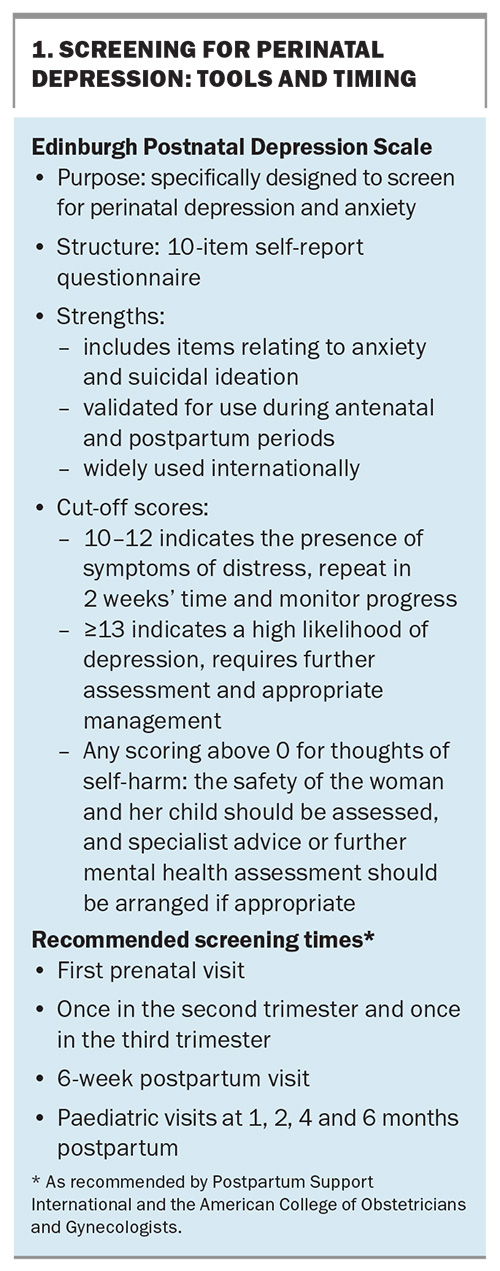
GPs play a pivotal role in identifying perinatal mental health concerns. This can be achieved by routinely using a validated screening tool, such as the Edinburgh Postnatal Depression Scale, and by asking all pregnant and postpartum women about symptoms of depression and anxiety (Box 1). Simple, direct questions such as ‘Have you been feeling down, depressed or hopeless?’ and ‘Have you been feeling anxious or excessively worried?’ can open the door to important conversations. It is also helpful to ask whether these feelings are interfering with their ability to care for themselves or their baby.
A history of bipolar disorder or psychosis in the patient or a first-degree relative warrants urgent referral to a perinatal mental health service, ideally early in pregnancy or during preconception. Women who present with unusual behaviour or marked anxiety (often a preoccupation with their own or their infant’s health) in the first postpartum month require a careful history to exclude postpartum psychosis. This condition occurs in about one in 600 births, carries a high risk of suicide and infanticide, and requires urgent referral to perinatal mental health services for inpatient psychiatric assessment and treatment.11 Prompt recognition and action are crucial.
Public mother–baby inpatient services have expanded in some Australian jurisdictions in recent years. Access remains limited and referral pathways vary. GPs should contact the local perinatal mental health intake service or mental health triage service to discuss urgency and facilitate timely assessment. Crisis teams may visit daily until a bed is available if the family can provide 24-hour support; however, caution is advised, as women may mask psychotic symptoms.
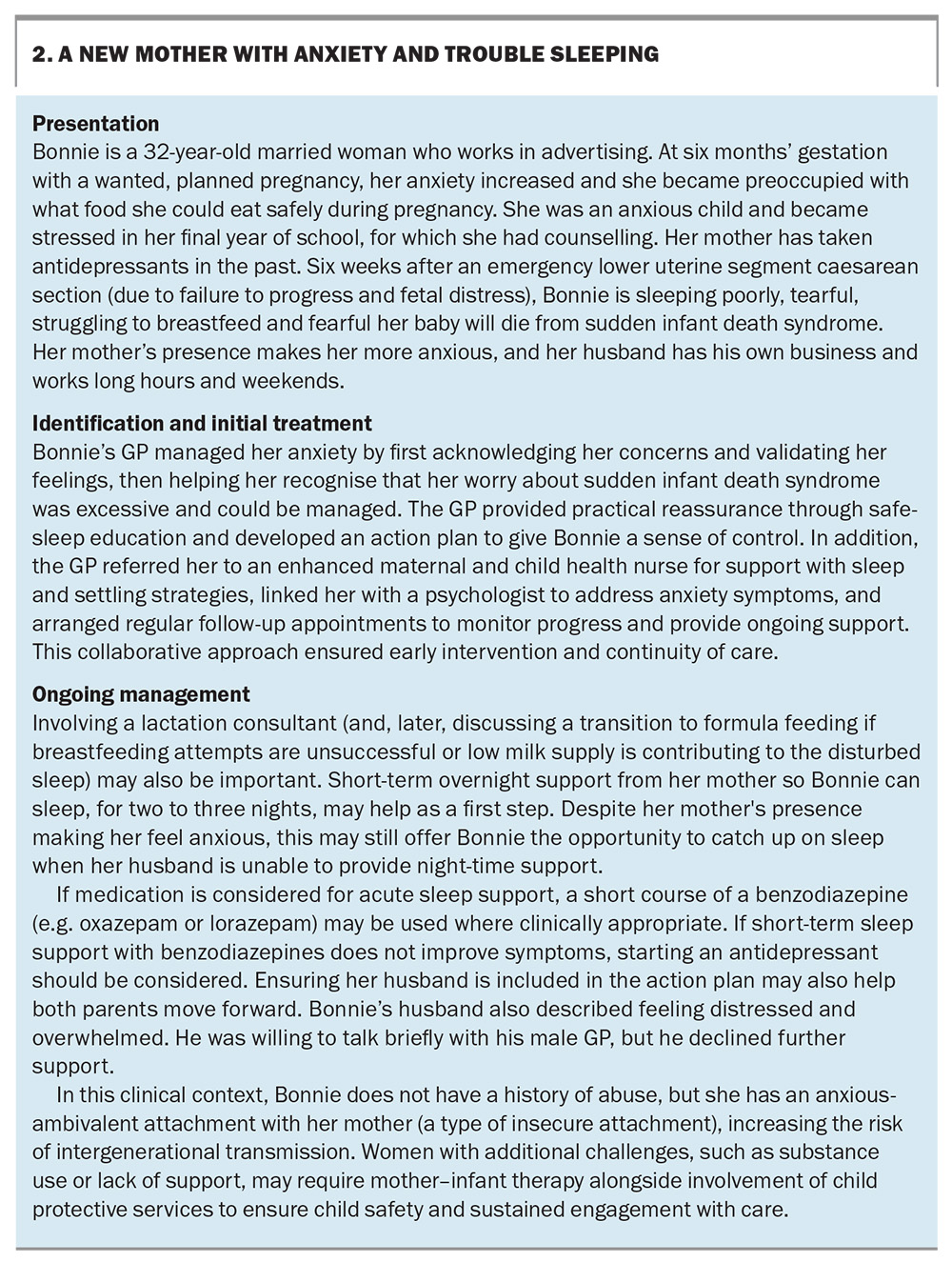
A case study of a new mother with anxiety and trouble sleeping after a recent emergency caesarean section is presented in Box 2.
Treatment approaches for mothers and fathers
Integrated, family-based care
The Mental Health Care in the Perinatal Period – Australian Clinical Practice Guidelines and the Canadian Network for Mood and Anxiety Treatments 2024 Clinical Practice Guideline emphasise a family-centred approach in the treatment of perinatal mood and anxiety disorders, integrating care across disciplines and targeting both parents.1,12,13 This includes screening both mothers and their partners during routine perinatal visits, offering psychoeducation using information based on practice guidelines and facilitating access to mental health services.13 Collaborative care models involving GPs, midwives, psychiatrists and psychologists are ideal for managing complex cases.
Psychotherapy
Psychotherapy remains a cornerstone of treatment for perinatal depression and anxiety. Cognitive behavioural therapy and interpersonal therapy are considered first-line interventions for mild to moderate perinatal depression and anxiety.13 These therapies can be delivered individually, in groups or, increasingly, via digital formats, which can enhance accessibility, especially for those facing geographic, financial or systemic barriers. GPs can provide information about these options and refer patients for therapy. Cost and long wait times can be barriers; as a result, antidepressant medication may be commenced before psychotherapy is able to start, although the reverse would ideally occur.
For fathers, emerging interventions are being tailored to address challenges such as masculinity norms, emotional literacy and co-parenting dynamics. These approaches aim to reduce stigma and improve engagement with mental health services. As seen in the case study in Box 2, Bonnie’s husband found talking with his (male) GP helpful, but he resisted other input.
Digital platforms and online interventions
Digital platforms for perinatal mental health have transformed access to mental health care.13,14 They provide structured, evidence-based support that can be used as a method of delivery for psychotherapy, as mentioned above, or as a complement to face-to-face care. During the coronavirus disease 2019 pandemic, such services were able to offer valuable alternatives for individuals unable to access traditional care because of location, cost or long waitlists.
Although digital platforms offer flexibility and reach, they must be implemented with appropriate safeguards. Risks such as suicide, self-harm and misinterpretation of advice without clinical oversight must be carefully managed. Providers can mitigate these risks by integrating screening tools, crisis protocols and clinical supervision into digital programs, alongside regular reviews by the person’s GP.
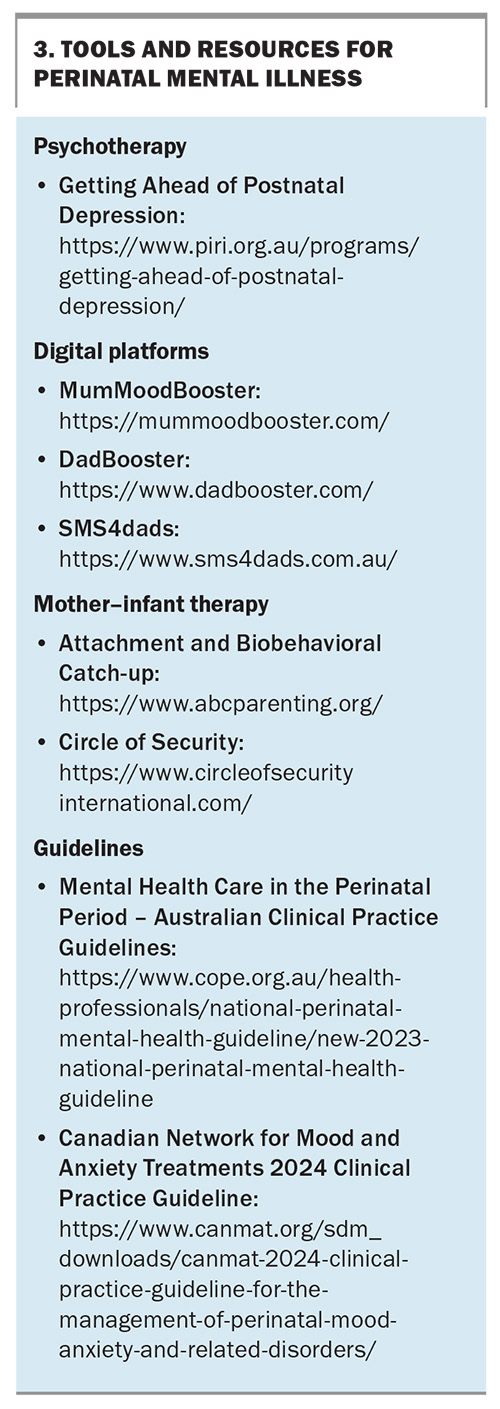
GPs can recommend online programs as an adjunct for postpartum mental health difficulties for both parents. Programs such as MumMoodBooster and DadBooster deliver online cognitive behavioural therapy modules tailored for new parents. They were adapted from the face-to-face program Getting Ahead of Postnatal Depression.15-17 They include interactive sessions, practical strategies for managing mood and anxiety, and tools for improving coping skills. Programs may also offer additional features such as partner support, text reminders and access to educational resources, improving flexibility and accessibility for families facing barriers to in-person therapy.
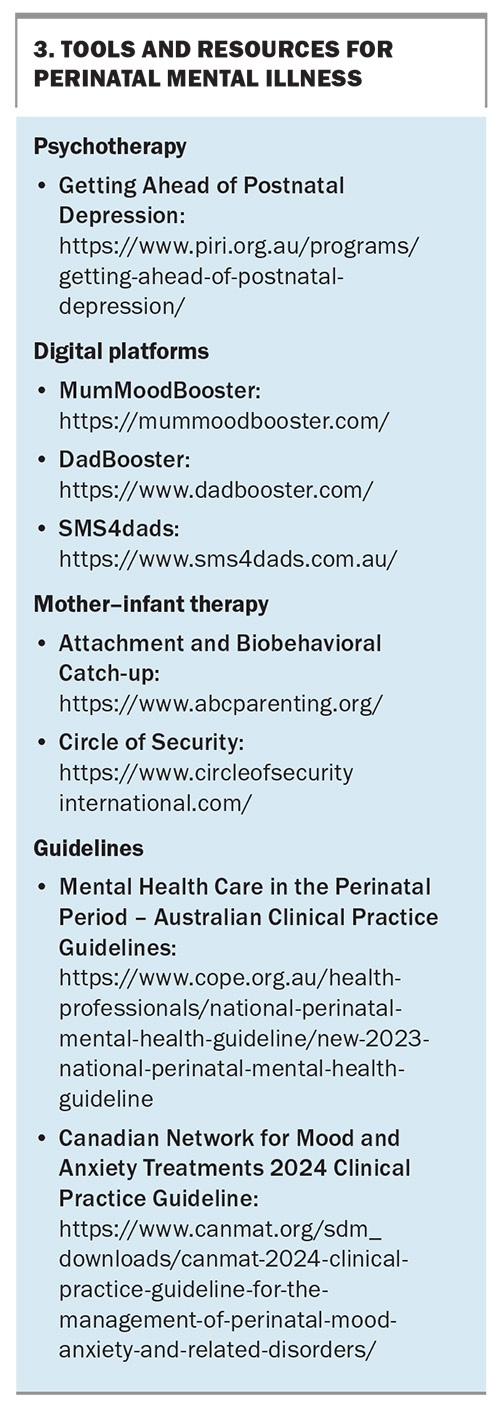
SMS4dads is a free national service that sends supportive text messages to fathers from 12 weeks into pregnancy and throughout the first year postpartum.18 Messages provide practical tips, emotional support and links to resources, helping fathers stay engaged and informed during the transition to parenthood. Box 3 summarises several tools and resources that can support the management of perinatal mental illness.
Mother–infant therapy
Treating maternal perinatal mental illness alone is often insufficient to resolve relationship difficulties.19 Underlying attachment issues from the mother’s own childhood can influence interactions through behaviours such as negative tone, miscuing or lack of responsiveness, with long-term consequences for the child’s social engagement, learning and mental health.19
GPs can observe parent–infant interactions and ask open questions. Warning signs include limited eye contact, poor responsiveness, difficulty soothing, or a parent appearing detached or overly anxious. Infants may show irritability, poor eye contact or minimal engagement. Questions such as ‘How do you feel when spending time with your baby?’ and ‘Do you find it easy to comfort your baby?’ can help identify concerns and guide referral.
Mother–infant relationships can improve with direct intervention.13 Programs like Attachment and Biobehavioral Catch-up and Circle of Security have strong evidence for enhancing sensitive caregiving and strengthening attachment (Box 3).20,21 Circle of Security offers both educational and therapeutic options, with face-to-face and online formats available. GPs can inform families about these programs, which are often run by community services and accessible to both parents.
Pharmacological management
For moderate to severe perinatal depression or anxiety, antidepressant therapy may be required. Selective serotonin reuptake inhibitors such as sertraline and escitalopram are often used and have established safety profiles in pregnancy and lactation.13 Medication choice should be guided by symptom severity, previous response and patient preference, with close monitoring for side effects.
Antidepressants are generally continued for 12 months before gradual tapering; longer treatment may be needed for women with histories of trauma. Future pregnancies should ideally be delayed until recovery is achieved. Nonbirthing partners may also benefit from pharmacological treatment when symptoms impair bonding or functioning
New directions in research
Recent research has highlighted allopregnanolone, a neuroactive steroid, as a promising target in the treatment of perinatal depression.22 The medication is not currently available in Australia.
Conclusion
Perinatal mental illness is not an isolated maternal issue; it is a family health concern that requires comprehensive, evidence-based and compassionate care. GPs play a pivotal role in early identification, treatment initiation, ongoing management and co-ordination of services. By widening the clinical lens to include partners and the needs of the whole family, while keeping the infant at the centre of care, we can improve outcomes for the entire family unit MT
COMPETING INTERESTS: Professor Buist has received research grants from the National Health and Medical Research Council; royalties from her fiction novels with Hachette Australia; consulting fees from Austin Health, Omega Medical and Zeep Locums; honoraria and support from the Royal Australian and New Zealand College of Psychiatrists for a conference and from the Sydney Opera House Trust for a talk; and payment from Coroners Court of Victoria and the Victorian Child Protection Service. Dr Wanigasekera: None.
References
1. Maternal Mental Health Leadership Alliance (MMHLA). Maternal mental health conditions and statistics: an overview. Arlington: MMHLA; 2024. Available online at: https://www.mmhla.org/articles/maternal-mental-health-conditions-and-statistics (accessed January 2026).
2. Chavis AT. Paternal perinatal depression in modern-day fatherhood. Pediatr Rev 2022; 43: 539-548.
3. Applegate JS, Shapiro JR. Neurobiology for clinical social work: theory and practice. 2nd ed. New York: W. W. Norton & Company; 2005.
4. Ogunye M, Hause N. Reflections on the attachment relationship between an infant and caregiver. Washington, DC: ZERO TO THREE; 2023. Available online at: https://www.zerotothree.org/resource/reflections-on-the-attachment-relationship-between-an-infant-and-caregiver/ (accessed January 2026).
5. Dieckmann L, Czamara D. Epigenetics of prenatal stress in humans: the current research landscape. Clin Epigenet 2024; 16: 20.
6. Álvarez-Mejía D, Rodas JA, Leon-Rojas JE. From womb to mind: prenatal epigenetic influences on mental health disorders. Int J Mol Sci 2025; 26: 6096.
7. MacBeth A, Morales MF, Golds L. Intergenerational transmission of mental health during the first 1,000 days of life. Nat Rev Psychol 2026: 1-15.
8. Moss KM, Reilly N, Dobson AJ, Loxton D, Tooth L, Mishra GD. How rates of perinatal mental health screening in Australia have changed over time and which women are missing out. Aust N Z J Public Health 2020; 44: 301-306.
9. Byatt N, Levin LL, Ziedonis D, et al. Enhancing participation in depression care in outpatient perinatal care settings: a systematic review. Obstet Gynecol 2015; 126: 1048‑1058.
10. Kikuchi S, Murakami K, Obara T, et al. One-year trajectories of postpartum depressive symptoms and associated psychosocial factors: findings from the Tohoku Medical Megabank Project Birth and Three-Generation Cohort Study. J Affect Disord 2021; 295: 632‑638.
11. Osborne LM. Recognizing and managing postpartum psychosis: a clinical guide for obstetric providers. Obstet Gynecol Clin North Am 2018; 45: 455-468.
12. Vigod SN, Frey BN, Clark CT, et al. Canadian Network for Mood and Anxiety Treatments 2024 clinical practice guideline for the management of perinatal mood, anxiety, and related disorders. Can J Psychiatry 2025; 70: 429-489.
13. Highet NJ, Expert Working Group and Expert Subcommittees. Mental health care in the perinatal period: Australian clinical practice guideline. Melbourne: Centre of Perinatal Excellence; 2023. Available online at: https://www.cope.org.au/uploads/images/Health-professionals/COPE_2023_Perinatal_Mental_Health_Practice_Guideline.pdf (accessed January 2026).
14. Bloch M, Tevet M, Onn R, et al. The long-term course and prognosis of postpartum depression: a retrospective longitudinal cohort study. Arch Womens Ment Health 2024; 27: 99-107.
15. Milgrom J, Danaher BG, Gemmill AW, et al. Internet cognitive behavioral therapy for women with postnatal depression: a randomized controlled trial of MumMoodBooster. J Med Internet Res 2016; 18: e54.
16. Danaher BG, Milgrom J, Seeley JR, et al. MomMoodBooster web-based intervention for postpartum depression: feasibility trial results. J Med Internet Res 2013; 15: e242.
17. The Parent Infant Research Institute (PIRI). DadBooster online treatment program. Melbourne: PIRI. Available online at: https://www.piri.org.au/programs/dadbooster-online-treatment/ (accessed January 2026).
18. Healthdirect. SMS4dads.] Canberra: Healthdirect; 2023. Available online at: https://www.healthdirect.gov.au/partners/sms4dads (accessed January 2026).
19. Slomian J, Honvo G, Emonts P, Reginster JY, Bruyère O. Consequences of maternal postpartum depression: a systematic review of maternal and infant outcomes. Womens Health (Lond) 2019; 15: 1745506519844044.
20. Dozier M, Bernard K, Roben CKP. Attachment and Biobehavioral Catch-Up. In: Steele H, Steele M, editors. Handbook of attachment-based interventions. 1st ed. New York: Guilford Press; 2017. p. 27-49.
21. Woodhouse SS, Powell B, Cooper G, Hoffman K, Cassidy J. The Circle of Security intervention: design, research, and implementation. In: Steele H, Steele M, editors. Handbook of attachment-based interventions. 1st ed. New York: Guilford Press; 2017. p. 50-78.
22. Schoretsanitis G, Walther S, Homan P, et al. Peripartum allopregnanolone blood concentrations and depressive symptoms: a systematic review and individual participant data meta-analysis. Mol Psychiatry 2025; 30: 1148-1160.
Single article purchases are temporarily unavailable due to site maintenance.
If you would like to purchase an article during this time, please email us at [email protected] with the article details and we'll assist you directly. We'll also let you know when online purchasing is available again.
Thank you for your patience and understanding.