
Not just another fever – recognising recurrent fever syndromes in children

Dr Bleathman is a Paediatric Rheumatology Advanced Trainee at Monash Children’s Hospital, Melbourne.
Dr Renton is a Paediatric Rheumatologist at Monash Children’s Hospital and the Royal Children’s Hospital, Melbourne.
Dr Tiller is a Paediatric Rheumatologist at Monash Children’s Hospital and the Royal Children’s Hospital, Melbourne, Vic.
SERIES EDITOR: Dr Louise Ward FRACP, MB BS, BPharm, representing the Education Training and Workforce Committee of the Australian Rheumatology Association.

Fever
Children's health
Fever in children is common, with infection being the cause in most cases. When infection is excluded, broader causes of recurrent and periodic fevers in children include rheumatic disease, malignancy and immunodeficiency. Autoinflammatory periodic fever syndromes are rare but important to consider, as targeted treatments can improve quality of life and prevent long-term morbidity.
- Most children with recurrent fevers do not have a periodic fever syndrome; infection is the most common cause of fever, regardless of the fever pattern.
- Periodic fever syndromes should be considered if fever episodes are recurrent, have a predictable pattern and are not explained by infection, and if the child is well between episodes.
- Measurement of inflammatory markers and a full blood count during a fever episode can help guide the diagnostic process.
- Referral of the patient to a paediatric rheumatologist or other specialist experienced in these conditions is appropriate in the setting of a suspected periodic fever syndrome.
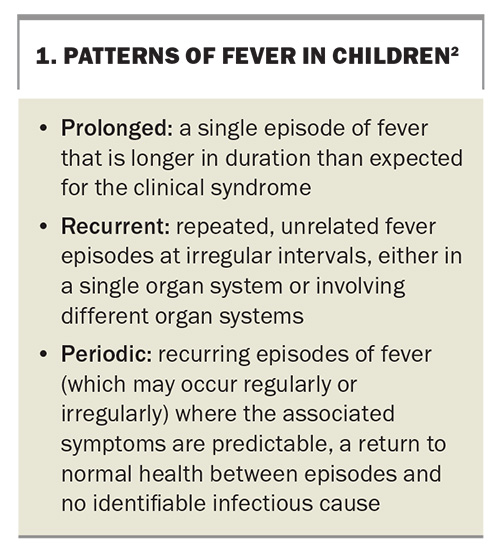
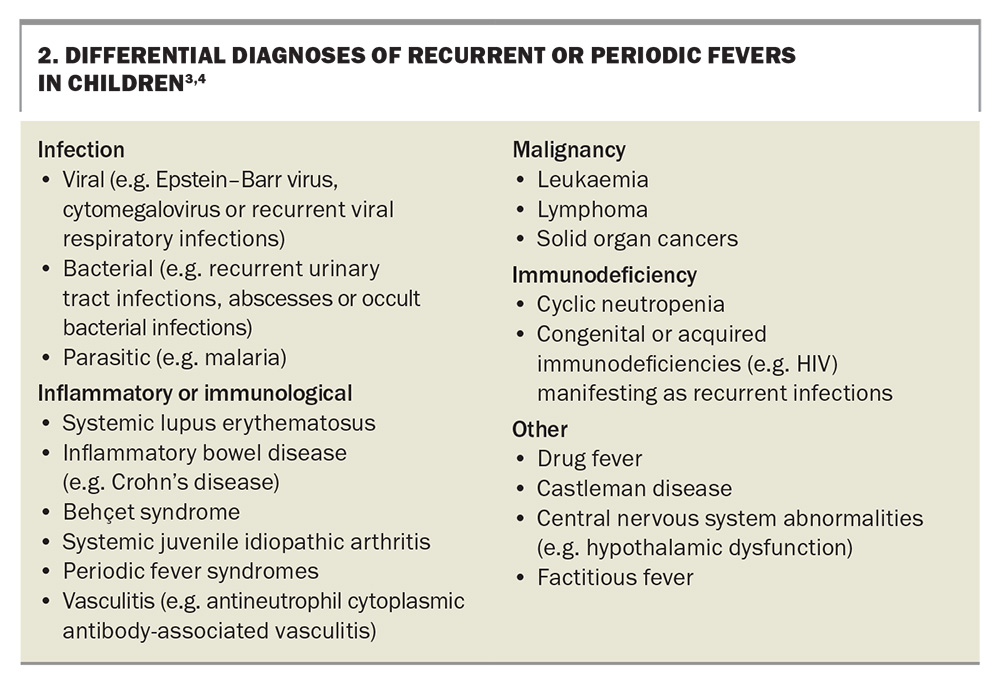
Fever is one of the most frequent paediatric presentations in primary care and is most often caused by infection, particularly respiratory infection, which accounts for the majority.1 Fevers can be acute or chronic, and can occur in various patterns such as prolonged, recurrent or periodic (Box 1).2 When infection is excluded, the differential diagnosis of recurrent fever in children includes rheumatic disease, malignancy and immunodeficiency, requiring careful assessment (Box 2).3,4
When assessing a child with fever, taking a thorough history is important, as the pattern of fever, associated symptoms and family history may provide important diagnostic clues. A thorough clinical examination, with attention paid to findings in the oropharynx, lymph nodes, musculoskeletal system and skin, can also be helpful. In cases of recurrent or periodic fevers, assessing organ involvement, the suspected aetiology and whether the child returns to baseline health between fever episodes can assist in directing further assessment. A diagnostic and management approach to recurrent fever is presented in the Flowchart.
-Tiller-Fever in children.jpg "Flowchart.")
A small proportion of children with recurrent fevers have a rheumatic disease, of which a smaller proportion have an autoinflammatory periodic fever syndrome. Autoinflammatory periodic fever syndromes are a group of rare disorders of the innate immune system characterised by unprovoked episodes of systemic inflammation. Management varies between specific syndromes and early recognition is important to prevent complications. This article reviews the clues that may suggest an autoinflammatory cause of recurrent fevers.
Understanding autoinflammation
The immune system can be broadly divided into two components: the innate and adaptive systems. The innate immune system provides a ‘first line of defence’ involving a rapidly activated, nonspecific response to pathogens. It acts via myeloid cells (e.g. macrophages and neutrophils), cytokines (particularly interleukin-1, interleukin-6 and tumour necrosis factor-alpha) and chemical mediators (e.g. complement). This is in contrast to the adaptive immune system, which is slower to respond but highly specific, involving lymphocytes (T and B cells) and immunological memory.5
The term ‘autoinflammatory’ has been used to differentiate diseases of the innate immune system from those that arise primarily from the adaptive immune system, which we call autoimmune diseases. Autoinflammatory diseases result from dysregulation of the innate immune system, leading to inflammatory episodes characterised by fevers and stereotyped symptoms, typically lasting a predictable duration and often with a predictable frequency.6
Clinical features of autoinflammatory periodic fever syndromes
The following clinical features are suggestive of an autoinflammatory periodic fever syndrome.
- Recurrent fevers: a proposed definition of recurrent fever is the presence of three or more episodes of fever in a six-month period (with no alternative cause such as infection), with an interval of at least seven days between episodes.7 The episodes often occur with a predictable pattern of duration and frequency and are termed ‘periodic’.
- Associated symptoms: these may include rash, serositis (including pleuritis, peritonitis and myocarditis), arthritis or mucosal ulcers. The episodes are typically stereotyped and have a similar constellation of symptoms each time.
- Absence of coryzal symptoms: no signs or symptoms of an intercurrent respiratory infection, such as cough and coryza, are present.
- Return to baseline: patients are generally well between episodes, with resolution of all signs and symptoms that manifest during a febrile episode.
- Raised levels of inflammatory markers: there is typically a marked elevation of C-reactive protein levels and erythrocyte sedimentation rate during an episode of fever, which typically normalise between episodes.4
Common autoinflammatory periodic fever syndromes
There are many rare autoinflammatory periodic fever syndromes described in the paediatric literature, and the list continues to grow as further discoveries of their genetic and biochemical aetiology are uncovered.8 A subset of the more common autoinflammatory periodic fever syndromes that are more likely to be encountered in the primary care setting are outlined in the Table.5,9-11
-Tiller-Fever in children.jpg "Table.")
Investigations
If historical and clinical features of a periodic fever syndrome are present, initial workup that may assist in the diagnostic process is uncomplicated and should include:
- inflammatory markers (e.g. C-reactive protein and erythrocyte sedimentation rate):
– at least moderately raised levels of inflammatory markers during an episode are consistent with the diagnosis
– normal inflammatory markers during an episode make the diagnosis unlikely
– between fever episodes, inflammatory markers may normalise - full blood count and blood film:
– may show leukocytosis during fever episodes
– consider haematological malignancy or immunodeficiency when interpreting abnormal cell counts, particularly cytopenia
– serial full blood counts may be requested in cases of suspected cyclic neutropenia, an important differential for recurrent fevers - liver function tests and urea, electrolytes and creatinine:
– abnormal findings may indicate an alternative systemic disease, for which further investigations may be needed.
If the diagnosis of a periodic fever syndrome is suspected, a specialist may order serum amyloid A or genetic testing. Serum amyloid A is an acute phase reactant that is a sensitive but nonspecific marker of inflammation. It can be used to monitor disease control, assess for the risk of developing amyloidosis and detect subclinical inflammation in the setting of familial Mediterranean fever (FMF).12
Genetic testing is considered when clinical features are suggestive of a monogenic autoinflammatory syndrome. Patient or parental consent is required, and the method of testing and list of candidate genes should be carefully considered before the test is requested. Specialist interpretation of the result is required, as a negative or inconclusive result does not always exclude the diagnosis, and treatment may still be indicated.13
Management
Patients with a suspected autoinflammatory periodic fever syndrome should be referred to a specialist with experience in the diagnosis and management of these conditions. This may include a paediatrician, paediatric rheumatologist, immunologist or infectious disease physician.
Treatment aims to reduce the frequency and severity of episodes; improve the quality of life by reducing time spent away from school, recreational activities and parental workplaces; and prevent long-term morbidity.
Corticosteroids are often used for a very short duration at the start of an episode with the aim of reducing the severity of symptoms and episode duration. The chronic use of systemic corticosteroids is limited by the long-term adverse effects.
Colchicine can be taken regularly to reduce the episode frequency and severity in several conditions (including FMF and periodic fever, aphthous stomatitis, pharyngitis and adenitis [PFAPA]). Importantly, it also reduces the long-term risk of developing amyloidosis in cases of FMF.14
Biological disease-modifying antirheumatic drugs, which act via the blockade of proinflammatory cytokines (e.g. interleukin-1 using anakinra or canakinumab), can be highly effective for some autoinflammatory conditions.
Tonsillectomy can be curative in children with PFAPA.7
Prognosis and long-term care
The course of periodic autoinflammatory fever syndromes varies between the different conditions. Amyloidosis is a severe complication of several autoinflammatory conditions including FMF, tumour necrosis factor receptor-associated periodic fever syndrome and cryopyrin-associated periodic syndrome, and can lead to long-term morbidity. Optimised disease control and regular assessment are essential for the prevention of this complication, which generally manifests clinically with renal involvement after many years of active inflammation.15 In the case of PFAPA, symptoms can resolve or reduce in severity as children enter adolescence or adulthood.16
Conclusion
Although the cause of most recurrent fevers in children is benign and self-limiting, such as viral infections, autoinflammatory periodic fever syndromes are rare but treatable conditions that should be considered when episodes are stereotyped and have no identifiable infectious cause. A targeted history, focused examination and simple investigations (such as measurement of inflammatory markers and a full blood count during a febrile episode) can help guide initial assessment. Early recognition and referral can prevent long-term complications such as amyloidosis, reduce the impact of repeated investigations and missed days of school, and improve the quality of life for children and their families. MT
COMPETING INTERESTS: None.
References
1. Valenzise M, D'Amico F, La Barbera G, et al. Retrospective analysis of fever in pediatric age: our experience over the last 5 years. Children (Basel) 2024; 11: 539.
2. Long SS. Distinguishing among prolonged, recurrent, and periodic fever syndromes: approach of a pediatric infectious diseases subspecialist. Pediatr Clin North Am 2005; 52: 811-835.
3. Federici S, Gattorno M. A practical approach to the diagnosis of autoinflammatory diseases in childhood. Best Pract Res Clin Rheumatol 2014; 28: 263-276.
4. Soon GS, Laxer RM. Approach to recurrent fever in childhood. Can Fam Physician 2017; 63: 756-762.
5. Kastner D. Autoinflammation: past, present, and future. In: Hashkes PJ, Laxer RM, Simon A. Textbook of autoinflammation, 1st Edition. Springer; 2019. p.3-15.
6. Cattalini M, Soliani M, Lopalco G, Rigante D, Cantarini L. Systemic and organ involvement in monogenic autoinflammatory disorders: a global review filtered through internists' lens. Intern Emerg Med 2016; 11: 781-791.
7. John CC, Gilsdorf JR. Recurrent fever in children. Pediatr Infect Dis J 2002; 21: 1071-1077.
8. Papa R, Gattorno M. New genes, pathways and therapeutic targets in autoinflammatory diseases. Nat Rev Rheumatol 2024; 20: 71-72. Erratum in: Nat Rev Rheumatol 2024; 20: 133.
9. Gattorno M, Hofer M, Federici S, Vanoni F, Bovis F, Aksentijevich I, Anton J, Arostegui JI, Barron K, Ben-Cherit E, Brogan PA, Cantarini L, Ceccherini I, De Benedetti F, Dedeoglu F, Demirkaya E, Frenkel J, Goldbach-Mansky R, Gul A, Hentgen V, Hoffman H, Kallinich T, Kone-Paut I, Kuemmerle-Deschner J, Lachmann HJ, Laxer RM, Livneh A, Obici L, Ozen S, Rowczenio D, Russo R, Shinar Y, Simon A, Toplak N, Touitou I, Uziel Y, van Gijn M, Foell D, Garassino C, Kastner D, Martini A, Sormani MP, Ruperto N; Eurofever Registry and the Paediatric Rheumatology International Trials Organisation (PRINTO). Classification criteria for autoinflammatory recurrent fevers. Ann Rheum Dis 2019; 78: 1025-1032.
10. Barron K, Kastner DL. Periodic fever syndromes and other inherited autoinflammatory diseases. In: Petty RE, Laxer RM, Lindsley CB, Wedderburn L, Fuhlbrigge RC, Mellins ED. Textbook of pediatric rheumatology, 8th Edition. Elsevier; 2020. p. 525-543.
11. Gaggiano C, Vitale A, Obici L, et al. Clinical features at onset and genetic characterization of pediatric and adult patients with TNF-α receptor-associated periodic syndrome (TRAPS): a series of 80 cases from the AIDA network. Mediators Inflamm 2020; 2020: 8562485.
12. Çakan M, Karadağ ŞG, Tanatar A, Sönmez HE, Ayaz NA. The value of serum amyloid A levels in familial Mediterranean fever to identify occult inflammation during asymptomatic periods. J Clin Rheumatol 2021; 27: 1-4.
13. Shinar Y, Obici L, Aksentijevich I, Bennetts B, Austrup F, Ceccherini I, Costa JM, De Leener A, Gattorno M, Kania U, Kone-Paut I, Lezer S, Livneh A, Moix I, Nishikomori R, Ozen S, Phylactou L, Risom L, Rowczenio D, Sarkisian T, van Gijn ME, Witsch-Baumgartner M, Morris M, Hoffman HM, Touitou I; European Molecular Genetics Quality Network. Guidelines for the genetic diagnosis of hereditary recurrent fevers. Ann Rheum Dis 2012; 71: 1599-1605.
14. Quintana-Ortega C, Seoane-Reula E, Fernández L, et al. Colchicine treatment in children with periodic fever, aphthous stomatitis, pharyngitis, and cervical adenitis (PFAPA) syndrome: a multicenter study in Spain. Eur J Rheumatol 2021; 8: 73-78.
15. Scarpioni R, Ricardi M, Albertazzi V. Secondary amyloidosis in autoinflammatory diseases and the role of inflammation in renal damage. World J Nephrol 2016; 5: 66-75.
16. Vanoni F, Theodoropoulou K, Hofer M. PFAPA syndrome: a review on treatment and outcome. Pediatr Rheumatol Online J 2016; 14: 38.