
Joining GPs in the fight against ageism: a practical clinical guide

Professor Peisah is Conjoint Professor at UNSW, Sydney; Clinical Professor at The University of Sydney, Sydney, NSW; Special Instructor at Chiang Mai University, Thailand; and President and Founder of Capacity Australia.
Seniors' health
Elder abuse
Ageism leads to significantly worse mental and physical health outcomes, wellbeing, life satisfaction and longevity. To address ageism in clinical practice, GPs can adopt several practical strategies, such as fostering professionalism and self-awareness, identifying internalised ageism, offering targeted counselling, advocating for the rights and needs of older adults, minimising avoidable hospital admissions and staying alert to potential elder abuse.
- Ageism is rampant across society and health care and has been for some time, leading to significantly worse mental and physical health outcomes, wellbeing, life satisfaction and longevity.
- Factors that mediate the adverse effects of ageism include:
– structural factors such as underdiagnosis and undertreatment of older people with reduced access to healthcare and treatment
– individual patient factors including health-associated behaviours, such as failure to engage in preventive or health-promoting behaviours and nonadherence with healthcare treatment and recommendations
– psychological factors such as integrating the negative stereotypes of ageing into self-image, which in turn affects both mental state and performance. - Practical clinical strategies that GPs can use to battle ageism in practice include demonstrating professionalism and insight, screening for self-ageism, providing ageism counselling, advocating for older patients, avoiding acute hospitalisation and maintaining vigilance for elder abuse.
There is a global pandemic of ageism in health that merely echoes that of wider society.1-3 To truly understand the pervasive impact of ageism, one needs to appreciate its broadest meaning; namely, ageism encompasses stereotypes (beliefs), prejudice (emotional responses) and discrimination (behaviour) based on age.4-6 A World Value Survey showed that one in two people report holding ageist stereotypes and prejudice, whereas one in three people in Europe perceive age discrimination.7,8 Most importantly, for the purposes of this article, a national survey undertaken in 2021 by the Australian Human Rights Commission found that 64% of older Australians reported experiencing ageism in its broadest sense in the previous five years.9
The consequences of ageism are well established. Ageism, particularly self-directed, internalised ageism (reported by 81% of adults), has negative effects on both mental health (specifically anxiety and depression) and physical health, as well as on general wellbeing and life satisfaction.10-14 This has also been established in an Australian sample.15 Remarkably, ageism is a life-or-death phenomenon, given that self-perceptions of ageing are also associated with longevity.16
Ageism is rampant across health care.1,17 The most comprehensive global systematic review and meta-analysis to date found that ageism led to significantly worse health outcomes across 11 health domains in all 45 countries included in the study. These domains included the following:
- denied access to health care and treatments
- exclusion from health research
- devalued lives (as assessed by age-rationing of social resources)
- lack of work opportunities
- reduced longevity
- poor quality of life and wellbeing
- poor social relationships
- risky health behaviours
- mental illness
- cognitive impairment
- physical illness.
Moreover, the prevalence of significant findings increased over the 25-year study period.1 Some of these domains provide clues about the mechanisms – structural and individual – by which the adverse effects of ageism are mediated. Regarding structural or systemic mechanisms, it is well established that older people are provided less access to healthcare services and treatment. They face more limited provision of medical information and withholding of treatment options for a range of conditions, remaining frequently underdiagnosed and undertreated.17-19 Moreover, inertia in response to acute deterioration in older patients possibly associated with ageism was one of the ‘human factors’ identified in a study of adverse serious events in health.20 Finally, ageism has been reported across disciplines and stages of training in health, demonstrated in medical students, physicians and physicians-in-training, nurses and social workers.12,21-26
The individual patient factors that mediate the adverse effects of ageism can be divided into physiological, behavioural and psychological. The physiological mechanisms proposed include a physiological stress response that can affect multiple organ systems, particularly the cardiovascular system.27 Behavioural responses include, at best, failure to engage in preventive or health-promoting behaviours or, at worst, risk-taking behaviours and nonadherence with healthcare treatment and recommendations. Finally, the psychological mechanisms are the most complex and involve integrating negative stereotypes of ageing (i.e. being a burden, being incompetent or lacking self-efficacy) into one’s self-image (Stereotype Embodiment Theory), which in turn affects both mental state and performance.27,28
There have been several calls for action in response to this somewhat intractable and ubiquitous problem in health care, made only worse by the COVID-19 pandemic.29-31 Who better to respond to this call than GPs, who are ideally placed to identify and address ageism in health? We should not miss the opportunity to mobilise this important frontline army in the battle against ageism. By focusing on some of these remediable structural and individual factors, this article aims to develop practical clinical strategies for GPs to utilise in this battle against ageism.
Strategies for GPs
Strategy 1: professionalism and self-awareness
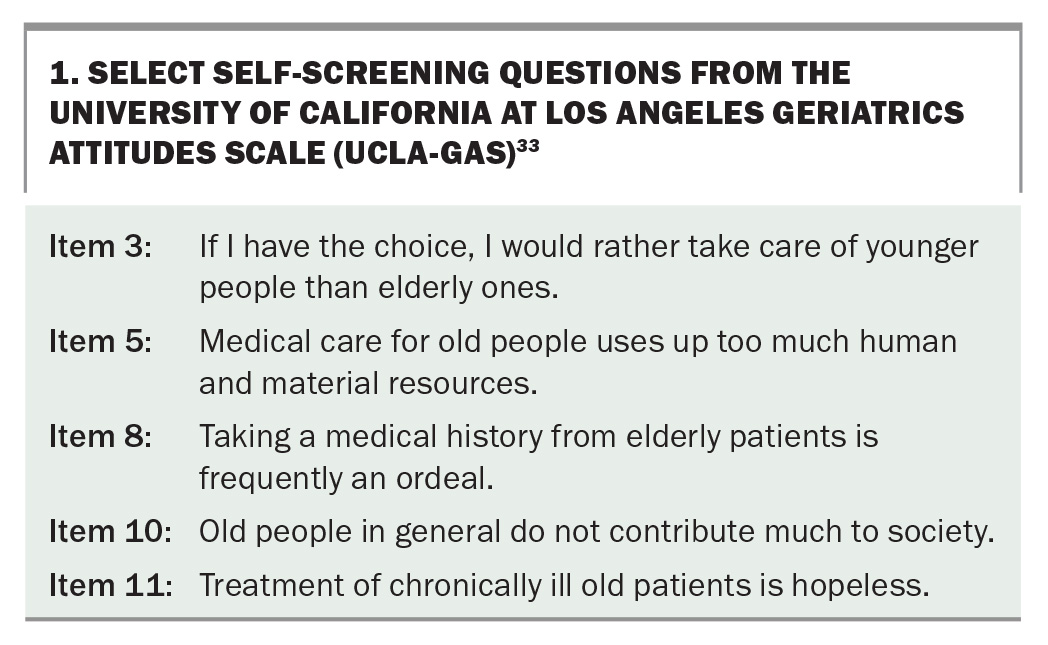
It is suggested that avoiding an ageist stance as a healthcare professional is part of professionalism. Given what we know about the prevalence of ageism among healthcare professionals, some reflection on one’s own attitudes towards older people and how they are treated is a good starting point. How does one reflect on the question ‘Am I ageist?’? Although recourse to one of the myriad screening scales is neither practical (given their length) nor relevant (as they target community attitudes towards older people), an easy and practical, albeit unvalidated, approach might be to use select items from the 14-item University of California at Los Angeles Geriatrics Attitudes Scale (UCLA-GAS) for self-screening (Box 1).32,33
Two additional screening questions to identify nihilism or apathy regarding mental illness and cognitive impairment in older people are affirmation of either of the two following statements (which are often used in health education):
- ‘it is normal to be depressed when you are old’
- ‘it is normal to be confused when you are old’.34
Finally, reflection on your attitude to your own ageing might be useful here.
Strategy 2: screen for self-ageism among your patients
Just as there are a myriad of general ageism scales, there are equally a myriad of scales that measure self-directed, internalised ageism. These include:
- the Anxiety about Ageing questionnaire
- the Attitudes to Aging questionnaire
- the Expectations Regarding Aging questionnaire
- the Reactions to Aging questionnaire.32
Any one of these might be used in a general practice setting; however, efficiency and, more importantly, engagement with the patient and the doctor–patient relationship might be better served by simply looking out for manifestations of stereotype embodiment (i.e., negative, nihilistic self-deprecatory comments regarding being old and getting old as articulated by the patient).27,28
Strategy 3: consider ageism counselling
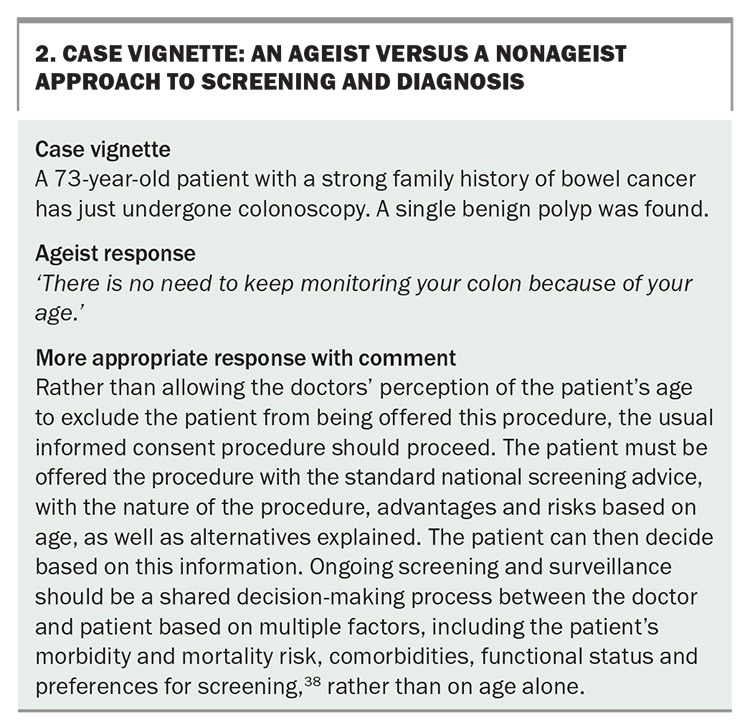
The key to this strategy is promoting realistic insight, adaptation and hope about ageing. It might be useful to draw upon Awareness of Age-Related Change (AARC), a theoretical, multidimensional construct encompassing health, physical, cognitive and social functioning; interpersonal relationships; lifestyle; and engagement. AARC provides a framework for facilitating individual awareness about how one’s performance, behaviour and ways of experiencing life have changed as a result of growing older.35,36 Although AARC encourages reflection on both positive and negative changes for each area, including gain- and loss-associated experiences, it is important to keep in mind that optimism about ageing buffers against the negative effects of ageism.35,37 A practical example of this is when a GP challenges ageism-driven beliefs (e.g. ‘I am too old to exercise’ or ‘that is not for me at my age’) that act as barriers to healthcare. GPs might further challenge such beliefs by citing examples of other patients whose behaviours and outcomes dispel such myths (i.e. exemplifying the aforementioned optimism). An example of an ageist versus a nonageist approach towards screening and diagnostic procedures is illustrated in Box 2.38
Strategy 4: facilitate access to care and treatment and be an advocate
Noting the aforementioned structural factors, such as reduced access to healthcare services and treatment, and a lack of treatment zeal that mediate ageism, it is incumbent upon us to act as advocates for our older patients. However, this is easier said than done given the trickle-down effect on GPs of a chronic, increasingly under-resourced healthcare system and waitlist crises.39 Contacting specialists directly is the natural first step, but this often leads to frustration both on the part of the GP and the patient. Although this places enormous pressure on GPs, some find heart in managing the delays by supporting patients while they wait, keeping track of patients on waiting lists, working collaboratively with advice from the specialist, upskilling and increasing their scope of practice. Nonetheless, there are risks, both medicolegal (from being forced to manage conditions beyond their skillset) and emotional (from exhaustion and dispiritment) in being an advocate in these times.
Strategy 5: hospital avoidance
Many of the structural factors that mediate the negative effects of ageism on health are at play in acute hospitals, where age rationing of health resources is the most prominent. The adverse experiences of older people, particularly those with frailty or dementia, in emergency departments and acute hospitals are well known.40-44 There are a range of acute ‘hospital in the home’ services, which go by various names (e.g. ‘flying squads’), usually provided by local acute public hospital geriatric services that are available to support the efforts of GPs to manage older patients in the community.45
Strategy 6: eyes wide open for elder abuse
The Ageism-Elder Abuse hypothesis is that elder abuse results from the conflation of sociocultural inequality with internalised ageism, mediated by exclusion or isolation, devaluation, depersonalisation, infantilisation, powerlessness and blame. The theory is that systemic norms, values, policies, behaviours and laws create an environment conducive to elder abuse.46 Failure to act in response to elder abuse is a corollary to this theory. This is exemplified by turning a blind eye to elder abuse in clinical practice.47 Instead, it is important to understand the role of GPs in detecting abuse and participate in the Eyes Wide Open for Elder Abuse global campaign.48,49 Not knowing what to do or being embroiled in and daunted by a complex medicolegal matter are some of the understandable reasons for inaction in healthcare. To remedy this, there are elder abuse hotlines in every state and territory. The elder abuse phone line (1800 ELDERHelp [1800 353 374]) is a free call phone number that automatically redirects callers seeking information and advice on elder abuse to the appropriate phone service in their state or territory.
Conclusion
Ageism is everywhere one looks. That is the point; we should look and act. We have a duty to do so as health practitioners, as identification and awareness raising are key to tackling this insidious, wicked problem. This is more so for GPs, the healthcare practitioners at the frontline of the battle against ageism. It is high time we took up the baton in health. MT
COMPETING INTERESTS: None.
References
1. Chang E-S, Kannoth S, Levy S, Wang S-Y, Lee JE, Levy BR. Global reach of ageism on older persons’ health: a systematic review PLoS One 2020: 15(1): e0220857.
2. North MS, Fiske ST. Modern attitudes toward older adults in the aging world: a cross-cultural meta-analysis. Psychol Bull 2015; 141: 993-1021.
3. Officer A, Thiyagarajan JA, Schneiders ML, Nash P, de la Fuente-Núñez V. Ageism, healthy life expectancy and population ageing: how are they related? Int J Environ Res Public Health 2020; 17: 3159.
4. Iversen TN, Larsen L, Solem PE. A conceptual analysis of ageism. Nordic Psychol 2009; 61: 4-22.
5. Ayalon L, Tesch-Römer C. Contemporary perspectives on ageism. 2018. Cham, Switzerland: Springer; 2018.
6. World Health Organization (WHO). Global Report on Ageism 2021. Geneva: WHO; 2021. Available online at: https://www.who.int/teams/social-determinants-of-health/demographic-change-and-healthy-ageing/combatting-ageism/global-report-on-ageism (accessed August 2025).
7. Officer A, Schneiders ML, Wu D, Nash P, Thiyagarajana JA, Bearda JR. Valuing older people: time for a global campaign to combat ageism. Bull World Health Organ 2016; 94: 710-710A.
8. Ayalon L. Perceived age, gender, and racial/ethnic discrimination in Europe: results from the European Social Survey. Educ Gerontol 2014; 40: 499-517
9. Australian Human Rights Commission (AHRC). What’s age got to do with it? A snapshot of ageism across the Australian lifespan September 2021. Sydney: AHRC; 2021. Available online at: https://humanrights.gov.au/our-work/age-discrimination/publications/whats-age-got-do-it-2021 (accessed August 2025).
10. Allen JO, Solway E, Kirch M, Singer D, Kullgren JT, Moïse V, Malani PN. Experiences of everyday ageism and the health of older US adults. JAMA Netw Open 2022; 5(6): e2217240.
11. Ayalon L, Gum AM. The relationships between major lifetime discrimination, everyday discrimination, and mental health in three racial and ethnic groups of older adults. Aging Ment Health 2011; 15: 587-594.
12. Chrisler JC, Barney A, Palatino B. Ageism can be hazardous to women’s health: ageism, sexism, and stereotypes of older women in the healthcare system. J Soc Issues 2016; 72: 86-104.
13. Han J, Richardson VE. The relationships among perceived discrimination, self-perceptions of aging, and depressive symptoms: a longitudinal examination of age discrimination. Aging Ment Health 2015; 19: 747-755.
14. Jackson SE, Hackett RA, Steptoe A. Associations between age discrimination and health and wellbeing: cross-sectional and prospective analysis of the English longitudinal study of ageing. Lancet Public Health 2019; 4(4): e200-e208.
15. Bryant C, Bei B, Gilson K, Komiti A, Jackson H, Judd F. The relationship between attitudes to aging and physical and mental health in older adults. Int Psychogeriatr 2012; 24: 1674-1683
16. Levy BR, Slade MD, Kunkel SR, Kasl SV. Longevity increased by positive self-perceptions of aging. J Pers Soc Psychol 2002; 83: 261-270.
17. Markham S. Professional ageism: the impact of ageism among research and healthcare professionals on older patients: a systematic review; the impact of ageism among legal and financial professionals on older people: systematised reviews. Sydney: UNSW; 2020. Available online at: https://hdl.handle.net/1959.4/70730 (accessed August 2025).
18. Wyman MF, Shiovitz-Ezra S, Bengel J. Ageism in the health care system: providers, patients, and systems. In: Ayalon L, Tesch-Römer C, eds. Contemporary Perspectives on Ageism. Vol 19. Cham, Switzerland: Springer; 2018: 193-212.
19. Buttigieg SC, Ilinca S, de Sao Jose JM, Larsson AT. Researching ageism in health-care and long term care. In: Ayalon L, Tesch-R¨omer C, eds. Contemporary Perspectives on Ageism. Vol 19. Cham, Switzerland: Springer; 2018: 493-515.
20. Mujuru C, Peisah C. Beyond error: a qualitative study of human factors in serious adverse events. J Healthc Risk Manag 2024; 44: 7-13.
21. Ben-Harush A, Shiovitz-Ezra S, Doron I, et al. Ageism among physicians, nurses, and social workers: findings from a qualitative study. Eur J Ageing 2016; 14: 39-48.
22. Higashi RT, Tillack AA, Steinman M, Harper M, Johnston CB. Elder care as "frustrating" and "boring": understanding the persistence of negative attitudes toward older patients among physicians-in-training. J Aging Stud 2012; 26: 476-483.
23. Jeyasingam N, McLean L, Mitchell L, Wand APF. Attitudes to ageing amongst health care professionals: a qualitative systematic review. Eur Geriatr Med 2023; 14: 889-908.
24. Reuben DB, Tschann JM, Croughan-Minihane M. Attitudes of beginning medical students toward older persons: a five-campus study. The University of California Academic Geriatric Resource Program Student Survey Research Group. J Am Geriatr Soc 1995; 43: 1430-1436.
25. Kusumastuti S. When contact is not enough: affecting first year medical students' image towards older persons. PLoS One 2017; 12(1): e0169977.
26. Wilson MAG, Kurrle S, Wilson I. Understanding Australian medical student attitudes towards older people. Australas J Ageing 2018; 37: 93-98.
27. Lamont RA, Swift HJ, Abrams D. A review and meta-analysis of age-based stereotype threat: negative stereotypes, not facts, do the damage. Psychol Aging 2015; 30: 180-193.
28. Meisner BA. A meta-analysis of positive and negative age stereotype priming effects on behavior among older adults. J Gerontol B Psychol Sci Soc Sci 2012; 67: 13-17.
29. Peisah C, Byrnes, A, Doron, I, Dark, M, Quinn G. Advocacy for the human rights of older people in the COVID pandemic and beyond: a call to mental health professionals. Int Psychogeriatr 2020; 32: 1199-1204.
30. Peisah C, de Mendonça Lima C, Verbeek H, Rabheru K. IPA and WPA-SOAP joint statement on the rights of older persons with mental health conditions and psychosocial disabilities. Int Psychogeriatr 2021; 12: 1-5.
31. Ayalon L, Peisah C, Lima CM, Verbeek H, Rabheru K. Ageism and the state of older people with mental conditions during the pandemic and beyond: manifestations, etiology, consequences, and future directions. Am J Geriatr Psychiatr 2021; 29: 995-999.
32. Ayalon L, Dolberg P, Mikulionienė S, et al. A systematic review of existing ageism scales. Ageing Res Rev 2019; 54: 100919.
33. Reuben DB, Lee M, David JW Jr, et al. Development and validation of a geriatrics attitudes scale for primary care residents. J Am Geriatr Soc 1998; 46: 1425-1430.
34. Morgan S, Pasco JC, Demers L, Young ME, Jindal SK. Combating ageism in medical education with narrative medicine. Gerontol Geriatr Educ 2025; 46: 5-16.
35. Wurm S, Diehl M, Kornadt AE, Westerhof GJ, Wahl HW. How do views on aging affect health outcomes in adulthood and late life? Explanations for an established connection. Dev Rev 2017; 46: 27-43.
36. Diehl MK, Wahl HW. Awareness of age-related change: examination of a (mostly) unexplored concept. J Gerontol B Psychol Sci Soc Sci 2010; 65B: 340-350.
37. Kang H, Kim H. Ageism and psychological well-being among older adults: a systematic review. Gerontol Geriatr Med 2022; 8: 23337214221087023.
38. Nee J, Chippendale RZ, Feuerstein JD. Screening for Colon cancer in older adults: risks, benefits, and when to stop. Mayo Clin Proc 2020; 95: 184-196.
39. Vukasin F. GPs face mounting pressures as wait list crisis extends to private specialists. Melbourne: NewsGP, RACGP; 2023. Available online at: https://www1.racgp.org.au/newsgp/clinical/gps-face-mounting-pressures-as-wait-list-crisis-ex (accessed August 2025).
40. Hoon LS, Mackey S, Hong-Gu H. Elderly patients’ experiences of care received in the emergency department: a systematic review. JBI Libr Syst Rev 2012; 10: 1363-1409.
41. Regen E, Phelps K, van Oppen JD, et al. Emergency care for older people living with frailty: patient and carer perspectives. Emerg Med J 2022; 39: 726-732.
42. Hao Q, Zhou L, Dong B, Yang M, Dong B, Weil Y. The role of frailty in predicting mortality and readmission in older adults in acute care wards: a prospective study. Sci Rep 2019; 9: 1207.
43. Wallis SJ, Wall J, Biram RW, Romero-Ortuno R. Association of the clinical frailty scale with hospital outcomes. QJM 2015; 108: 943-949.
44. Fogg C, Griffiths P, Meredith P, et al. Hospital outcomes of older people with cognitive impairment: an integrative review. Int J Geriatr Psychiatr 2018; 33: 1177-1197.
45. Jain S, Gonski PN, Jarick J, Frese S, Gerrard S. Southcare Geriatric Flying Squad: an innovative Australian model providing acute care in residential aged care facilities. Intern Med J 2018; 48: 88-91.
46. Pillemer K, Burnes D, MacNeil A. Investigating the connection between ageism and elder mistreatment. Nat Aging 2021; 1: 159-164.
47. Elder abuse in New South Wales / General Purpose Standing Committee No. 2 [Sydney, N.S.W.] : the Committee, 2016. [xx, 186] p. ; 30 cm. (Report no. 44 / General Purpose Standing Committee No. 2). Paragraphs 5.47 & 5.48. Sydney: NSW Parliament; 2016. Available online at: https://www.parliament.nsw.gov.au/Pages/home.aspx (accessed August 2025).
48. Ries NM, Mansfield E. Elder abuse: The role of general practitioners in community-based screening and multidisciplinary action. Aust J Gen Pract 2018; 47: 235-238.
49. Peisah C. Elder Abuse International training program on older persons’ mental health & well-being: advanced skills [Live]. Cambodia: Capacity Australia; 2024.