

October 2025
Father’s passive smoke exposure before puberty may impair lung function in future generations
Melanie Hinze
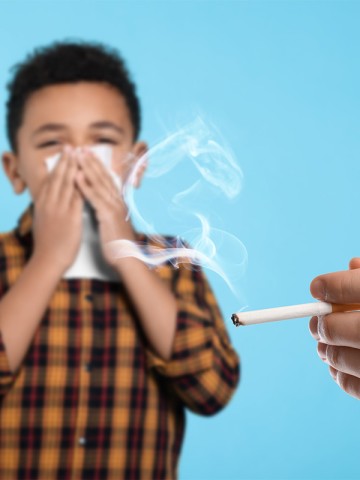
Children born to men who were exposed to passive smoke before completing puberty show a higher risk of impaired lung function lasting into midlife, according to new research published in Thorax.
Using data from 890 father–offspring pairs from the Tasmanian Longitudinal Health Study, researchers analysed spirometry results from the offspring that had been taken at six time points between the ages of 7 and 53 years. Nearly 69% of fathers reported that they had been exposed to passive smoke before the age of 15 years.
The researchers found that by age 53 years, offspring of fathers who had been exposed to passive smoke before completing puberty were significantly more likely to have a below average forced expiratory volume in one second (FEV1) and an early low-rapid decline FEV1 over forced vital capacity (FEV1/FVC) trajectory.
The effect was stronger if the offspring had also been exposed to passive smoke during their own childhood, and both paternal or offspring smoking and childhood respiratory illnesses explained only a small proportion of the observed effects.
Joint senior author, Professor Shyamali Dharmage, who leads the Allergy and Lung Health Unit at the University of Melbourne, Melbourne, said the key message of this paper was the importance of advising parents not to smoke around their children.
‘This is particularly important if the parents themselves were already unavoidably exposed to passive smoking during childhood,’ she said.
‘Smoking around children not only harms their immediate health but, as our findings suggest, may also adversely affect lung development in future grandchildren,’ she added.
Professor Shyamali told Medicine Today that the likely mechanism was through epigenetic changes in germ-line chromosomes (eggs, sperm) – ‘a rather alarming prospect,’ she added.
Together, the authors, who also included joint senior author Dr Dinh Bui and first author Mr Jiacheng Liu, concluded that paternal prepubertal passive smoke exposure might adversely affect lung function across generations, independent of later smoking behaviours. They suggested that reducing children’s exposure to tobacco smoke could benefit not only their immediate health but also that of future generations.